

My desk is tucked into the corner of my living room, which also happens to be my dining room and my reading nook. There is no dedicated office, no built-in shelving, and no room for a sprawling monitor setup. What I do have is a narrow surface, a handful of smart storage tools, and a system that keeps things from piling up by Tuesday every week. Small desk organization for WFH does not require a full room or a big budget. It requires a clear method.
These home organization tips are written for real apartment life: rental walls you cannot touch, surfaces measured in inches, and the constant tension between work mode and living mode. Whether your desk is a secondhand find pushed against a closet wall or a floating shelf above your bed, these small space organization steps will help you claim it as a workspace that actually functions.
Key takeaways
- Vertical space above your desk is your biggest untapped storage asset in a small apartment.
- Keeping your desk surface at roughly 80 percent clear at all times makes it easier to start work and easier to mentally leave it at the end of the day.
- Renter-friendly storage tools like adhesive hooks, freestanding risers, and clip-on organizers do the same job as permanent fixtures without affecting your deposit.
My Desk Used to Be a Drop Zone
For a long time, my desk was where everything landed: mail, hair ties, receipts, a book I meant to return two months ago. Once I cleared it down to just a tray, a single supply cup, and my laptop, it stopped being a stressor and started feeling like somewhere I actually wanted to sit. Small changes, but they made the whole corner of my apartment feel different.
Step-by-step
Start Here: Set the Foundation
1. Define your desk zones before buying a single organizer

Before adding any new storage, sit at your desk and identify three zones: active (things you touch every day), reference (things you need weekly), and overflow (things that do not actually belong on your desk at all). Most small desk clutter comes from mixing all three together. Separating them mentally first tells you exactly what kind of organizer you need and where it should live. This single step prevents you from buying a 10-slot pen holder when two slots would actually be enough.
Tip: Spend five minutes clearing your desk completely, then only put back what fits in your active zone. Everything else gets relocated before you shop.
2. Anchor your setup with one primary tray or mat

A desk tray or a simple cork mat creates a visual boundary for your active work zone. When your laptop, notebook, and one pen live inside that boundary, the rest of the surface reads as clear, even when the room around it is less tidy. This is one of the most effective apartment organization ideas for people who cannot dedicate a full room to WFH. It signals the edge of your workspace without requiring any permanent fixtures. Choose a tray that fits your desk without overhanging the edges.
Tip: A low-profile leather or cork tray is easy to slide aside when you need to use the surface for something else in the evening.
Go Vertical: Renter-Friendly Wall and Surface Lifts
3. Mount a small shelf above your desk using no-drill brackets

A floating shelf above your monitor or eye level is the single biggest storage upgrade you can make to a small desk setup. No-drill adhesive shelf brackets rated for five to ten pounds can hold a small plant, a speaker, sticky notes, and a couple of reference books without touching your rental walls with a single screw. This moves items off your desk surface and into vertical space, which is almost always wasted in small apartments. Measure twice before ordering because even a few inches of shelf depth matters on a narrow desk.
Tip: Keep the shelf at or just above eye level so it does not block light or create a cramped feeling over your workspace.
4. Use adhesive cable clips to route cords along desk edges

Cord clutter is one of the fastest ways a small desk starts to feel chaotic. Adhesive cable clips press onto the underside or back edge of your desk and hold charging cables, monitor cords, and headphone lines flat against the surface so they are out of sight and not tangling on your chair. This is a genuinely renter-friendly storage solution because the clips peel off cleanly and cost almost nothing. Run your most-used cable through a clip at the front edge of your desk so it is always ready to grab without hunting.
Tip: Label each cable with a small piece of washi tape so you are not unplugging the wrong thing in a hurry.
5. Clip a small organizer to the side panel of your desk

Side-panel clip organizers hang off the edge of a desk without drilling or sticking anything to the wall. They are perfect for holding a notepad, a few pens, scissors, or sticky notes in a spot that keeps them reachable without taking up surface real estate. This is one of those small space organization tricks that feels almost too simple until you try it and realize how much desk space you get back. Look for a clip-on version made of silicone or powder-coated metal so it does not scratch a rental desk surface.
Tip: If your desk has a drawer, use the clip organizer only for things you grab while actively working, not for storage.
Surface Strategy: Make Every Inch Count
6. Set up a monitor riser to create hidden storage underneath
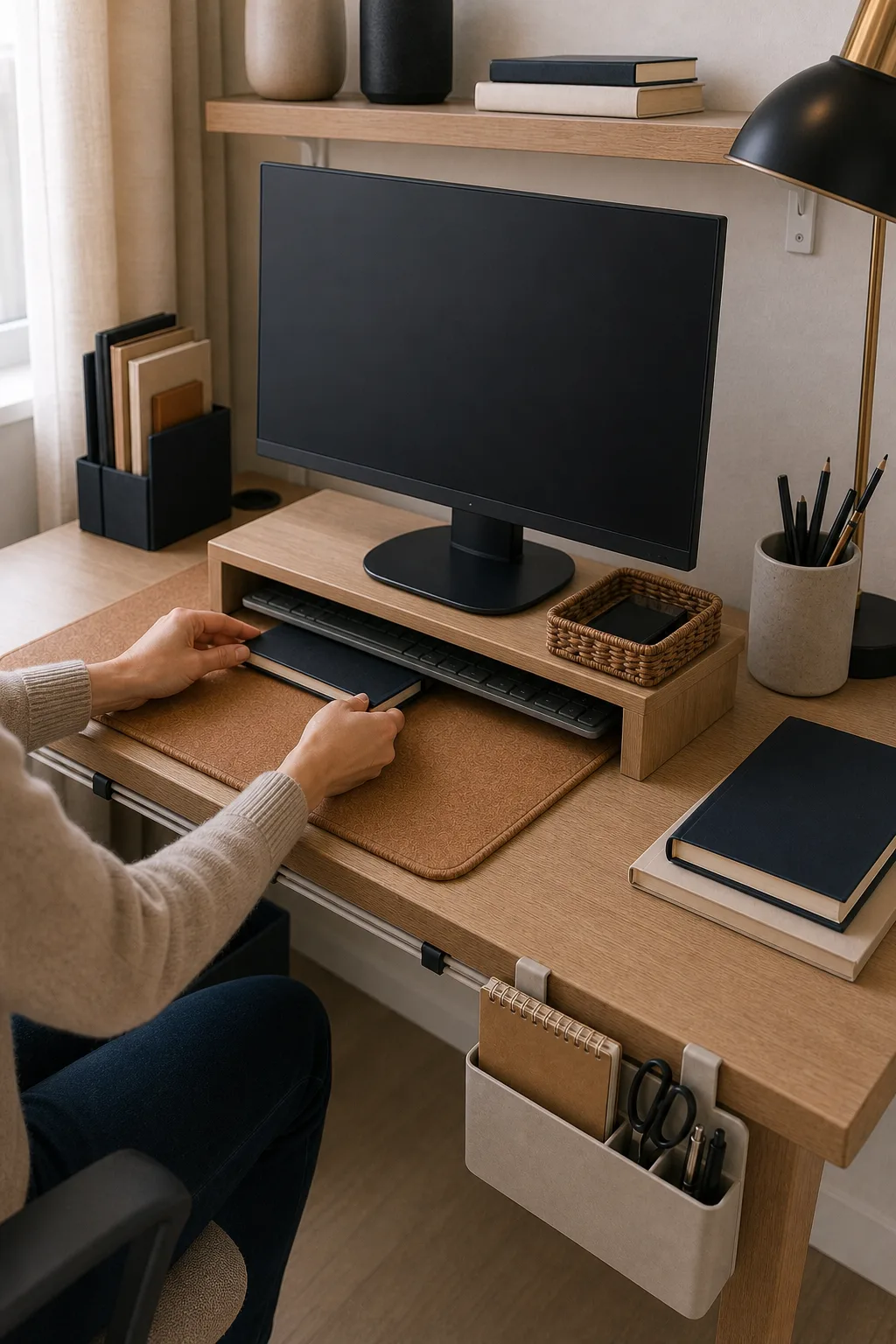
A monitor riser or laptop stand raises your screen to a healthier eye level and opens up a slot of clear storage underneath it. That underneath space is ideal for a keyboard, a slim notebook, or a small tray holding your most-used tools. This trick works equally well with a riser you buy or one you build from a few stacked books. For small desk organization with WFH in mind, the riser is doing double duty: ergonomic support and surface organization in one move.
Tip: Choose a riser with a built-in USB hub if your laptop is your only device. It reduces the number of separate cables on your surface.
7. Contain your supplies in one small cup or single-drawer box
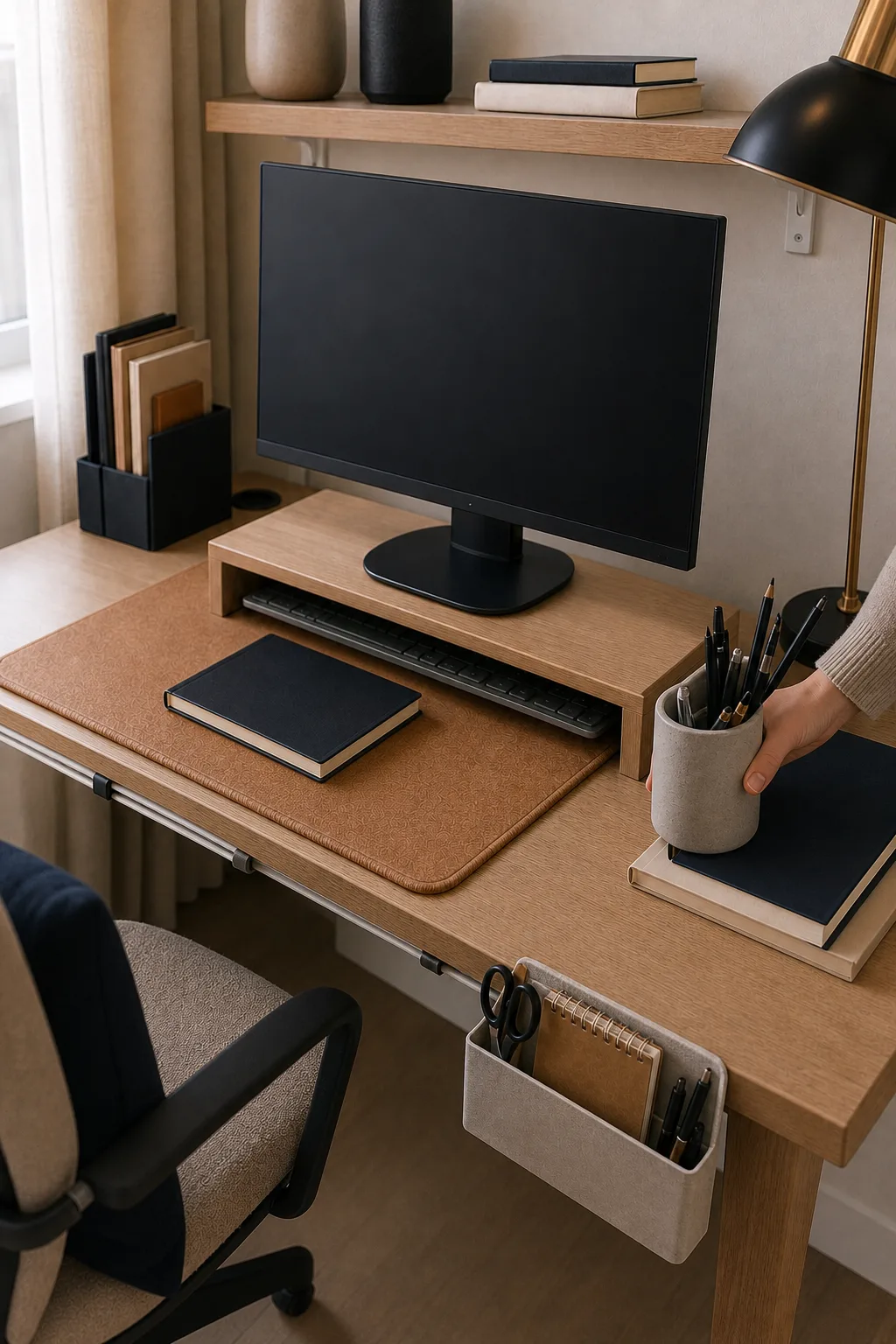
The most common small desk organization mistake is spreading supplies across three or four holders. One cup for pens, one tray for paper clips, one box for sticky notes, and suddenly half your desk is organizers. Consolidate into a single well-chosen container, whether that is a ceramic cup, a small divided box, or a compact drawer unit. Keep only what you use in a given week. Everything else moves to a nearby drawer, shelf, or supply bag stored in a closet.
Tip: Do a weekly desk reset on Friday afternoon. Pull everything out of your supply container, toss what is empty, and return only what you used.
8. Create a paper inbox with a single vertical file holder
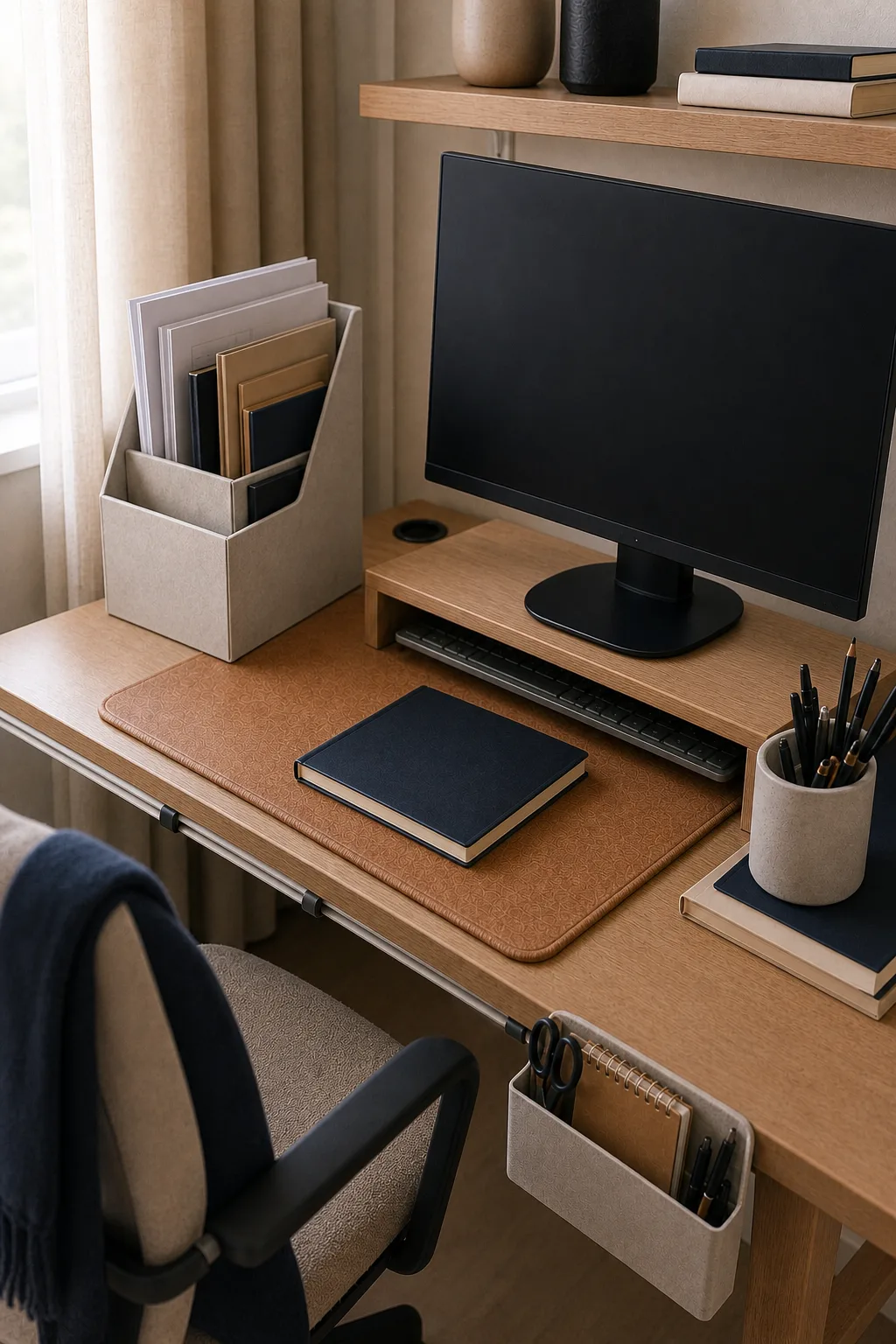
Paper is the enemy of a clean small desk. Bills, printed documents, notebooks, and mail stack up fast and make a tight surface feel unworkable. A single vertical file holder or slim document stand gives paper a home that is not your desk itself. Label one slot incoming and one slot to file so paper flows through and does not sit permanently. This is one of those basic home organization tips that small-space WFH setups genuinely cannot skip.
Tip: Process your paper inbox once a week. If a document has not moved in two weeks, it probably belongs somewhere other than your desk.
Off-Desk Storage: Keep the Surface Clear
9. Store rarely used supplies in a labeled pouch inside a nearby closet
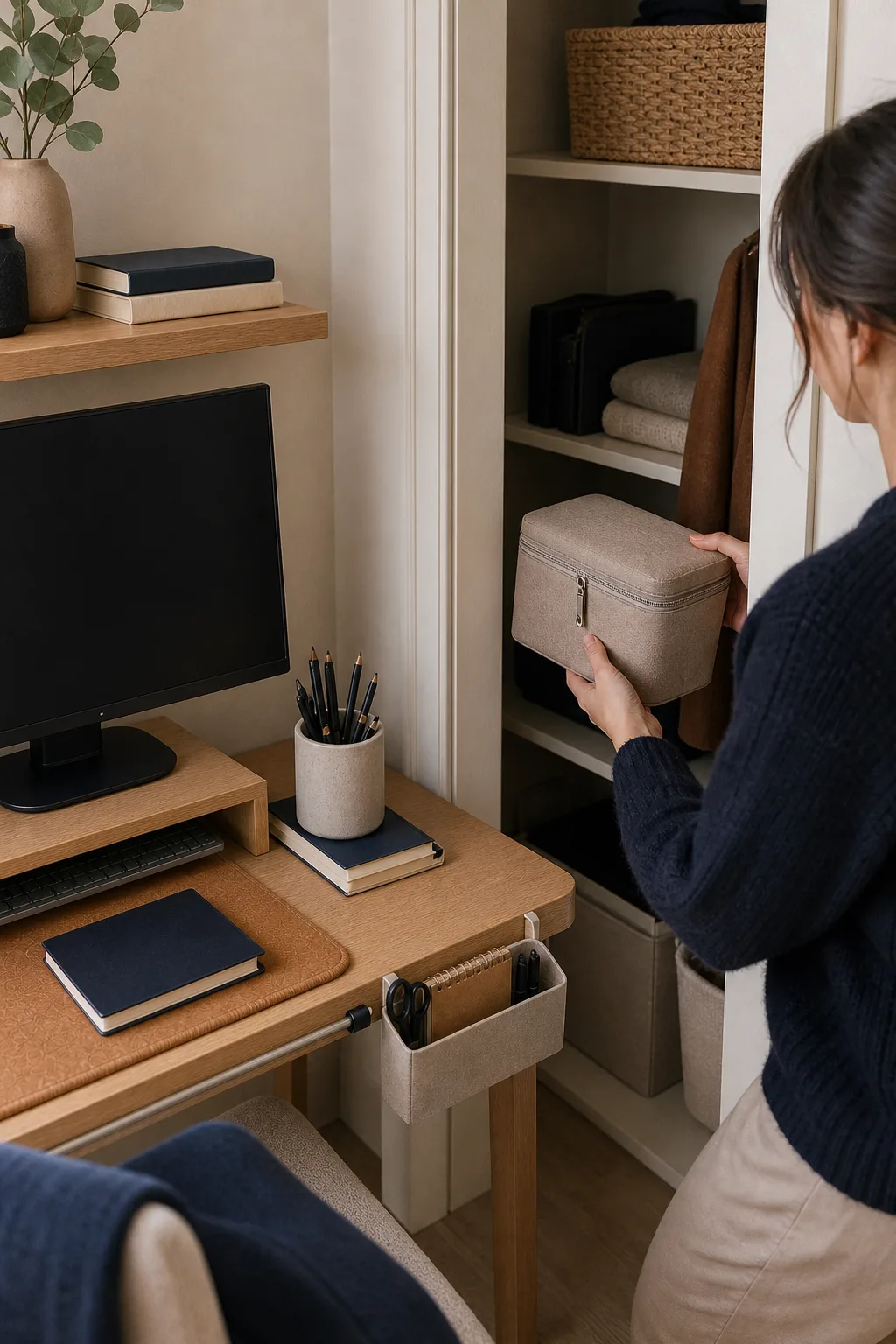
Not everything you might need at your desk needs to live at your desk. Spare chargers, extra notebooks, backup batteries, and tape rolls can live in a labeled zipper pouch stored in a closet shelf or a nearby cabinet. This is especially practical in studio apartments where your desk is never far from your closet anyway. Pulling a pouch out once a month is a small inconvenience compared to the benefit of a clear, calm surface every single day.
Tip: Use a clear or mesh zipper pouch so you can see the contents without opening it.
10. Hang a pegboard panel beside your desk using picture-rail hooks

A small pegboard does not need to be drilled into the wall. Lean it against the wall behind your desk, prop it on a shelf, or hang it from picture-rail molding using S-hooks if your apartment has crown molding. Pegboards are one of the best renter-friendly storage tools for a WFH desk because they hold headphones, scissors, small bins, and a whiteboard without taking any desk surface at all. Start with a panel about half the width of your desk so it does not overwhelm the space visually.
Tip: Paint the pegboard a color that matches your wall before setting it up. It will look intentional rather than improvised.
11. Add a small under-desk drawer unit on wheels for flexible storage

A rolling two or three-drawer unit tucks under your desk and slides out when you need it, making it one of the most flexible apartment organization ideas for a WFH setup. Use the top drawer for active daily supplies, the middle for reference materials, and the bottom for things you access less often. Because it is on wheels, you can pull it to another part of your apartment when you are done working, which helps you mentally close out your workday in a small space where work and life share the same square footage.
Tip: Look for a unit that is two inches narrower than your desk depth so it does not stick out past the front edge when tucked in.
Maintain It: Build the Habit
12. Do a two-minute desk reset at the end of every workday

The best small desk organization system in the world falls apart without a maintenance habit. A two-minute reset at the end of each workday, putting pens back, filing paper, closing notebooks, wiping the surface, is what keeps a small WFH desk functional week after week. In a small apartment where your desk is also visible from your couch or bed, this reset does something extra: it signals that work is done and the space is yours again. It is one of the simplest home organization tips with the biggest daily payoff.
Tip: Set a phone reminder at the same time each afternoon so the reset becomes as automatic as shutting your laptop.
FAQ
What is the best small desk organization setup for a studio apartment?
In a studio, your desk needs to work hard and disappear when you are off the clock. A monitor riser with under-riser storage, a single supply cup, a clip-on side organizer, and a rolling drawer unit you can tuck away are the core four. Keep your surface at about 80 percent clear so the desk does not dominate the room visually when you are not working.
How do I organize a small WFH desk without drilling into rental walls?
Adhesive shelf brackets, clip-on organizers, freestanding pegboards, and cable clips are all strong renter-friendly storage options. They hold real weight, stay put during daily use, and come off cleanly when you move. Always check the weight rating on adhesive products before loading them up, and press them firmly for at least 60 seconds when applying.
How do I stop my small desk from getting cluttered so fast?
Clutter usually comes from not having a clear home for things, so everything lands on the desk by default. Define one spot for each category of supply, active, reference, and overflow, and do a two-minute reset at the end of each workday. Those two habits alone will keep a small desk consistently clear.
Can I use my kitchen or closet shelf as desk overflow storage?
Absolutely. In a small apartment, storage does not have to live right at your desk. A labeled zipper pouch on a closet shelf or a small basket on a nearby kitchen shelf can hold backup supplies, extra paper, and rarely used items without cluttering your desk surface. Proximity matters less than having a clear, consistent home for each thing.
Save this guide so you can come back to it the next time your desk starts to feel unworkable. If you want more renter-friendly organization ideas delivered straight to your inbox, the Nest & Narrow newsletter is a good place to start.